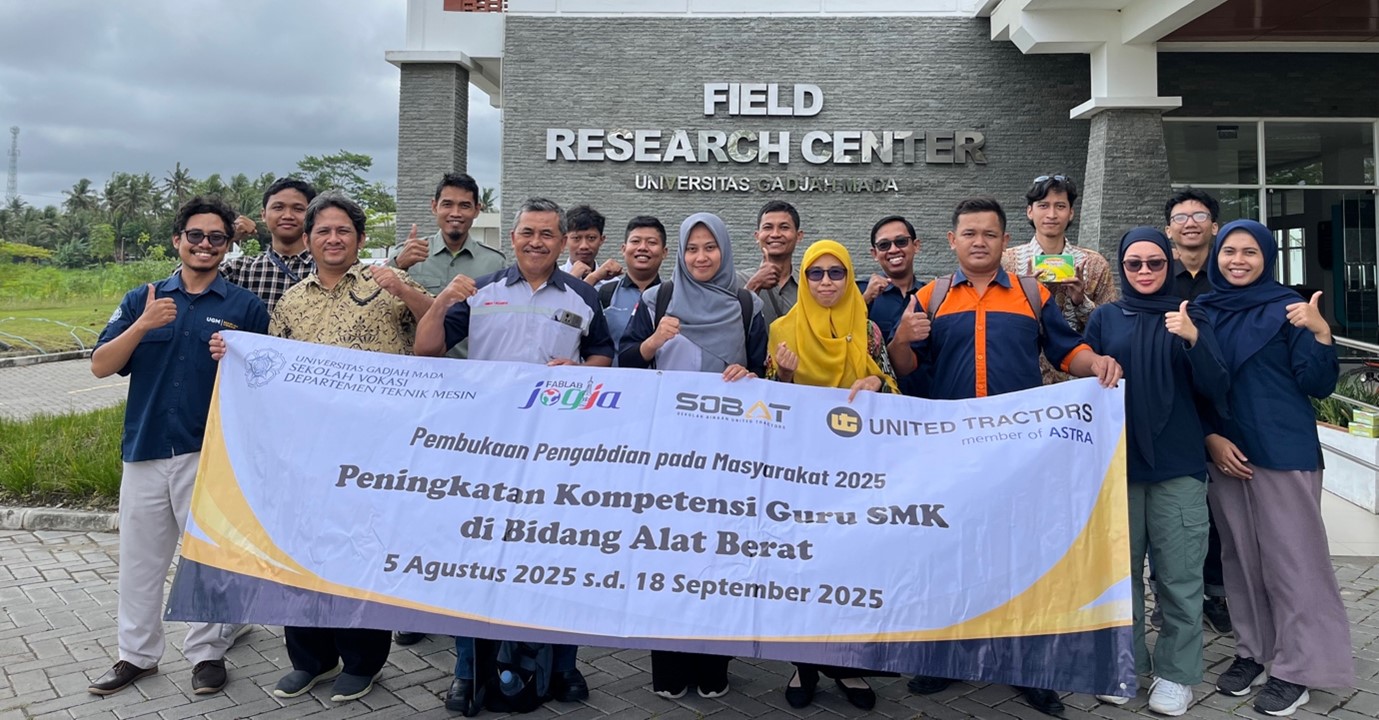
Yogyakarta, September 2025 — The Department of Mechanical Engineering, Vocational College of Universitas Gadjah Mada (DTM SV UGM) organized a community service program titled “Enhancing Vocational School Teachers’ Competence in Heavy Equipment through Reverse Engineering Technology Training” held from September 8–10, 2025, at both the DTM SV UGM and Fablab Jogja Indonesia, located within the Field Research Center (FRC) UGM, Kulon Progo.
The program was led by Yosephus Ardean Kurnianto Prayitno, along with lecturers and students from DTM SV UGM: Setyawan Bekti Wibowo, Handoko, Sugiyanto, Agustinus Winarno, Ilham Ayu Putri Pratiwi, Tofaenal Akhyar, Luthfi Athaya Wicaksono, and Ahmad Muhsin Al Mataromi. They were supported by Ahmat Hari Setiyawan, technical staff from the CoE Fablab Jogja Indonesia, and industrial collaborators from PT United Tractors, Tbk. Semarang Branch, Josua Aditya Manuel and Muhammad Novan Budi Prasetya.
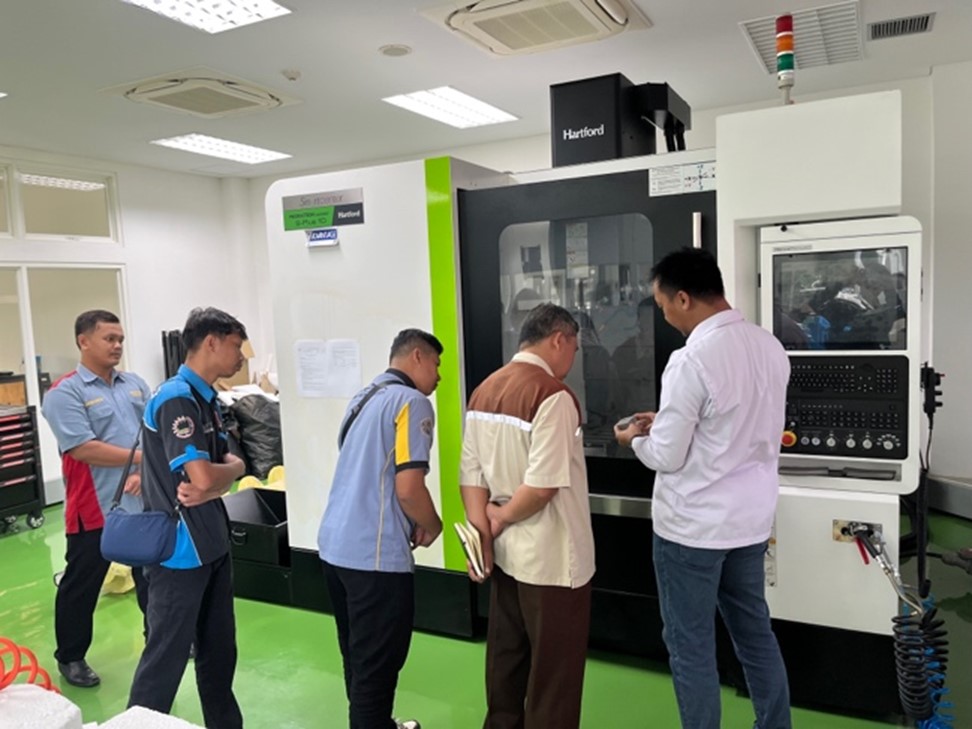

The initiative responds to the growing demand for strengthening the competence of vocational school teachers in the heavy equipment sector amidst the rapid transformation toward Industry 4.0. An initial assessment at SMKN 1 Ngawen, Gunungkidul, revealed a gap between industrial requirements and teaching capacity—particularly in implementing reverse engineering, and the application of digital-based hydraulic and pneumatic systems. Through this training, participants acquired practical skills in 3D scanning, CAD modeling, 3D printing, CNC routing, and laser cutting, as part of an integrated digital manufacturing learning process.
Conducted interactively with a problem-based learning (PBL) approach, the training provided hands-on experience using FabLab Jogja Indonesia’s facilities. Participants explored step-by-step applications of reverse engineering in replicating heavy-equipment components such as travel devices, hydraulic couplings, and transmission systems, guided by lecturers, students, and industrial practitioners.
Additionally, a digital module and online learning platform were provided to ensure program continuity.
The results indicated significant improvement in participants’ conceptual understanding and technical capabilities in applying digital fabrication technologies. This initiative serves as a strategic step to strengthen the pedagogical competence of vocational teachers and bridge the gap between vocational education and modern industrial needs.
The program also demonstrates DTM SV UGM’s continued commitment to fostering sustainable collaboration among academia, industry, and local government to enhance vocational education relevance and innovation.
This initiative contributes directly to several Sustainable Development Goals (SDGs), particularly SDG 4 (Quality Education), SDG 9 (Industry, Innovation, and Infrastructure), and SDG 17 (Partnerships for the Goals) by promoting human resource development, technology transfer, and cross-sector collaboration for sustainable vocational education.