
Yogyakarta, November 19, 2026 – The Department of Mechanical Engineering (DTM), Vocational College, Universitas Gadjah Mada (UGM), held an online International Guest Lecture via Zoom Meeting on Thursday (November 19). The event featured Associate Professor Chung-Ping Chang from the Department of Mechanical and Energy Engineering, National Chiayi University (NCYU), Taiwan, who delivered a presentation entitled “Development of Two-dimensional Laser Encoder System Using Geometric Error Reduction Technology.”

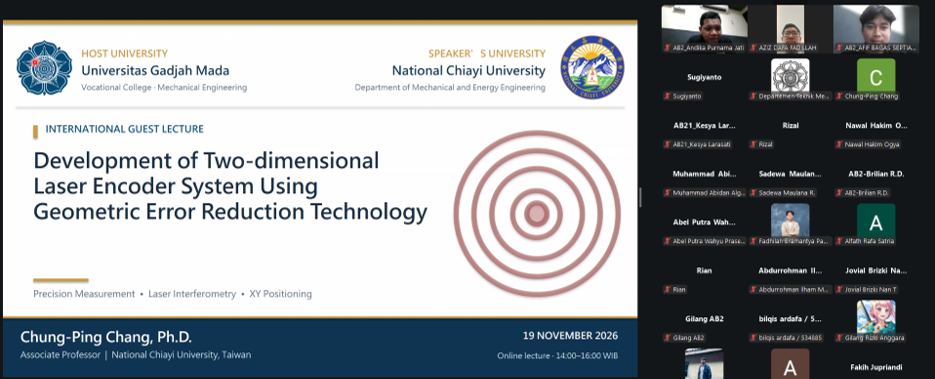
The lecture, held from 2:00 to 4:00 p.m. Western Indonesia Time (WIB), was attended by students and academic members of the Department of Mechanical Engineering, UGM Vocational College. The session was moderated by Ilham Saputra, S.Tr.T., M.Sc., Ph.D., and opened with welcoming remarks by the course lecturer, Ir. Irfan Bahiuddin, S.T., M.Phil., Ph.D. The event provided students with an opportunity to explore developments in precision measurement technology and its applications in mechanical engineering.
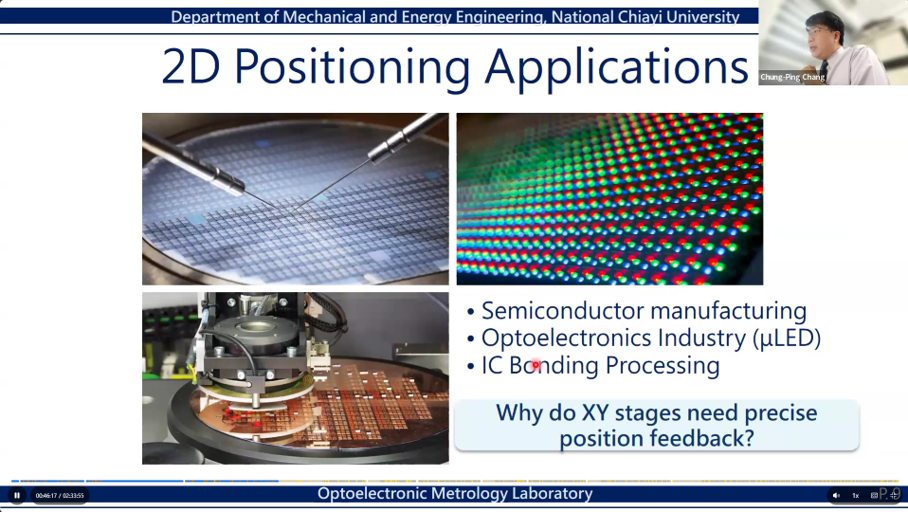
During his presentation, Associate Professor Chung-Ping Chang discussed the development of a two-dimensional (2D) laser encoder system based on laser interferometry for position measurement along the X and Y axes. The technology is designed to support precision measurement requirements in two-dimensional positioning systems, which are widely used in applications such as semiconductor manufacturing, the optoelectronics industry, and IC bonding processes.
One of the main challenges addressed in the lecture was the effect of geometric errors on measurement accuracy, particularly Abbe error, cosine error, straightness error, and squareness error. The speaker explained that high sensor resolution alone does not guarantee measurement accuracy if the geometry and configuration of the measurement system are not properly designed. Therefore, the proposed system applies the Abbe principle through a common reference point to reduce the influence of geometric errors.

In terms of system design, the developed encoder uses heterodyne laser interferometry with a dual-frequency He-Ne laser source. Its optical configuration and signal processing are designed to provide both displacement information and movement direction along the X and Y axes. Quadrature phase-shifted signals and differential signal processing also play important roles in improving signal reliability. The integrated design incorporates three avalanche photodetectors (APDs) and shared optical components to support two-dimensional measurement.
The results presented included positioning, straightness, and squareness tests. The interferometer achieved a theoretical displacement resolution of 15.8 nanometers. Furthermore, the squareness test on a two-dimensional positioning system showed a reduction in error from 226.8 arcseconds to 165.6 arcseconds, representing an improvement of approximately 27%. These findings demonstrate the potential of laser encoder development for high-precision two-dimensional position measurement.

Following the presentation, the event continued with an interactive question-and-answer session. Students had the opportunity to engage directly with the speaker, ask questions, and deepen their understanding of laser interferometry, geometric error reduction, and the challenges involved in developing precision measurement systems. The discussion also highlighted the relevance of measurement technology to machine development and modern manufacturing processes.

The International Guest Lecture was part of the Department of Mechanical Engineering, UGM Vocational College’s efforts to enrich students’ learning experiences through engagement with international academics. In addition to broadening students’ perspectives on measurement technology and optical metrology, the event is expected to encourage interest in engineering research and technological development while strengthening knowledge exchange between Universitas Gadjah Mada and National Chiayi University.
The event contributes to the Sustainable Development Goals (SDGs), particularly SDG 4 (Quality Education) through enriched learning experiences and international academic perspectives; SDG 9 (Industry, Innovation and Infrastructure) through exposure to precision measurement innovations relevant to industrial needs; and SDG 17 (Partnerships for the Goals) through knowledge exchange and the strengthening of international academic networks.