
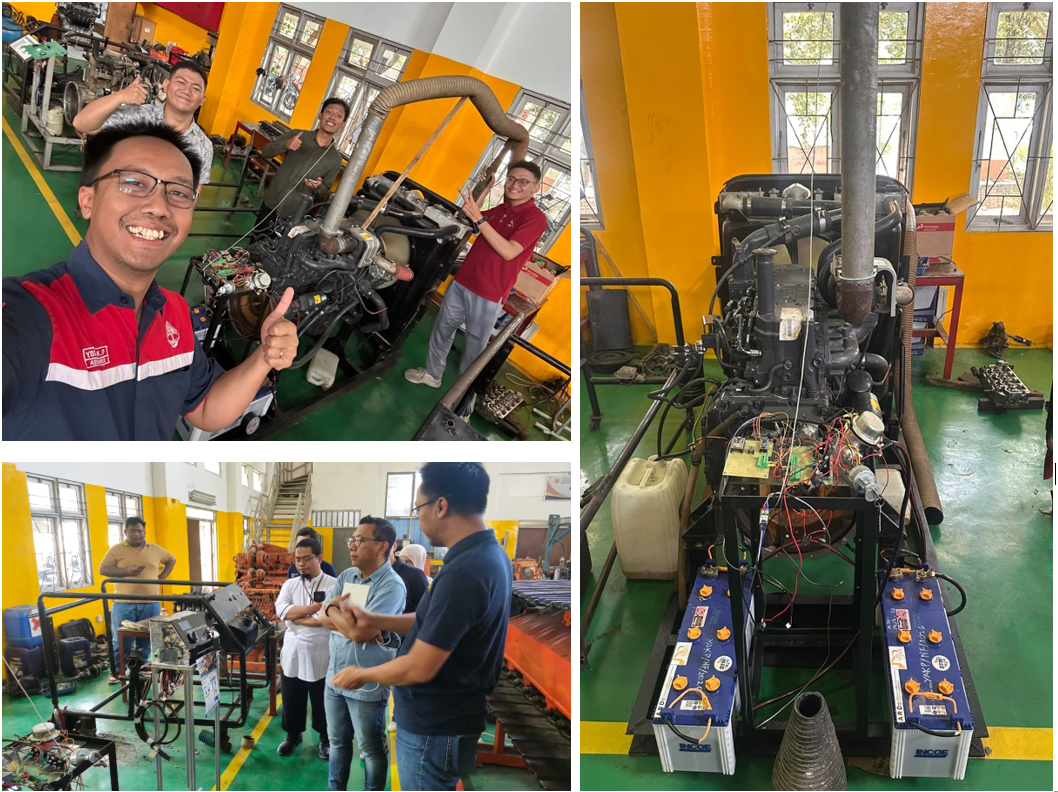
SLEMAN, YOGYAKARTA – The Heavy Equipment Management and Maintenance Engineering (TPPAB) study programme, Department of Mechanical Engineering, Vocational College, Universitas Gadjah Mada (DTM SV UGM), has completed an engine test bench (ETB) for the Komatsu SAA6D107E-1 common-rail diesel engine, the power unit of the PC200-8 excavator. The facility was built at the Industrial Machine Maintenance Laboratory of DTM SV UGM between April and October 2026. It is designed to revisit low power, a problem that heavy equipment frequently suffers in the field.
The research is led by Dr. Eng. Ir. Yosephus Ardean Kurnianto Prayitno, S.T., M.Eng., IPM., known as Dr. Ade, Head of the TPPAB programme. The lecturer team comprises Dr. Ir. Setyawan Bekti Wibowo, S.T., M.Eng., IPM., ASEAN.Eng., Ir. I. Aris Hendaryanto, S.T., M.Eng., IPM., Dr. Ilham Ayu Putri Pratiwi, S.T., Ir. Nugroho Santoso, S.T., M.Eng., and Dr. Ir. Bambang Hari Priyambodo, S.T., M.Eng. The students involved are Nasrul Fuad, Abram Adityaswara and Muhammad Tri Rayhanda. The work is supported by two partners: PT United Tractors Tbk as the industry partner and Xi’an University of Technology, China, as the international academic partner.
According to Dr. Ade, low power is one of the most common complaints about excavators in mining and construction. The engine cannot deliver the power required, so productivity drops and fuel consumption rises. He emphasized that a major cause is a disrupted fuel supply. High-blend biodiesel can form sludge that clogs the water separator and pre-filter, reducing the fuel flow to the common-rail system. The problem is often noticed only after engine power has already fallen, so a facility is needed to study it safely and under control.
The ETB was developed with the ADDIE approach (Analysis, Design, Development, Implementation, Evaluation). The frame was designed from UNP 80 steel channel measuring 1850 × 945 × 1400 mm and validated by static load simulation, with a safety factor above 2.5, to carry the 535 kg engine. The team then integrated the fuel, cooling and 24 V electrical systems for the ECM. A monitoring system based on Arduino Nano and ESP32 shows fuel flow rate and fuel flow velocity (FFV), as well as coolant, oil, engine block and exhaust temperatures, in real time on a web dashboard.
The key novelty of the facility is its FFV-based low-power simulation. A valve in the low-pressure fuel line, upstream of the feed pump, can be set to four openings (100%, 75%, 50% and 25%). This allows filter blocking seen in the field to be reproduced in the laboratory without risking a working machine.
The activity was also visited by PT United Tractors Tbk, represented by Mr. Himawan Sutanto, Corporate Social Responsibility & Corporate Communication Manager, who reviewed the ETB and its monitoring system first-hand.
Dr. Ade explained that the ETB is the first stage (2026) of the research roadmap Advanced Monitoring System for Green Manufacturing Equipment. The roadmap continues with an in-situ hydraulic monitoring system in 2027 and integration on a PC200-8 unit in 2028. Beyond research, the ETB gives vocational students hands-on access to modern common-rail systems, which have been hard to study because laboratories usually have only conventional diesel engines.
The activity supports the Sustainable Development Goals (SDGs):
- SDG 4 (Quality Education): an industry-relevant teaching platform for common-rail engines.
- SDG 7 (Affordable and Clean Energy): support for efficient fuel use in heavy-equipment diesel engines.
- SDG 9 (Industry, Innovation and Infrastructure): an innovative testing and diagnostic facility for the mining and construction sectors.
- SDG 12 (Responsible Consumption and Production): condition-based maintenance that keeps fuel consumption and emissions in check.
This research is funded by the Vocational College, Universitas Gadjah Mada, through the Research and Publication Grant Program (Program Hibah Riset dan Pembuatan Artikel Publikasi) 2026.